

Quick Answer
Grape seed extract is a concentrated extract of grape seeds, rich in antioxidant compounds called proanthocyanidins (also known as OPCs). It's most studied for antioxidant support and heart health markers: according to the NIH, reviews suggest it may modestly affect LDL cholesterol, triglycerides and diastolic blood pressure, though results aren't definite. Lab studies also show activity against Candida yeast. It's generally well tolerated. Grape seed extract is not the same as grapefruit seed extract.
A Nutritionist's Take
"I want to be upfront: grape seed extract isn't an ingredient I've worked with much one-on-one, so I'm not going to pretend to be an expert on it. What I can do is point you to what the research actually shows, and be clear about where the evidence is solid and where it's still early."
— Jordan Dorn, Certified Nutritionist
I'd rather be upfront than overstate things, so this article sticks closely to what the research and reputable sources actually say about grape seed extract: what it is, what it's been studied for, how strong that evidence is, and how to use it safely.
In this article 6 sections
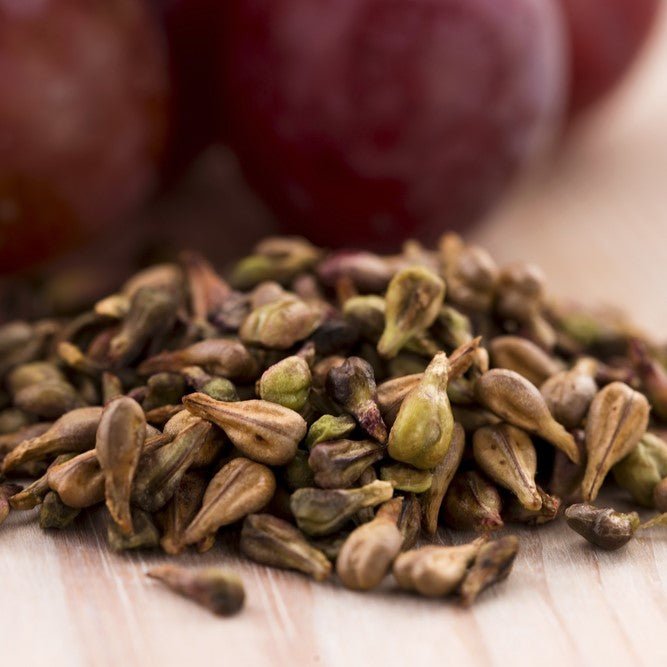
What Is Grape Seed Extract?
Grape seed extract is made from the seeds of grapes (Vitis vinifera), often those left over from winemaking and grape juice production. The seeds are rich in flavonoids, especially proanthocyanidins, along with catechin, epicatechin and gallic acid. Proanthocyanidins have shown strong free radical scavenging activity in research, which is why grape seed extract is best known as an antioxidant supplement [1].
Grape Seed Extract vs. Grapefruit Seed Extract
These two get mixed up constantly, but they're completely different products. Grape seed extract comes from grape seeds and is valued mainly for its antioxidants. Grapefruit seed extract is made from grapefruit seeds and pulp and is usually discussed for its antimicrobial properties. If that's the one you were looking for, read our guide to grapefruit seed extract for candida.
What the Research Says
Antioxidant Support (Most Established)
Your body constantly produces free radicals during normal metabolism, and antioxidants help keep them in balance. Grape seed proanthocyanidins are potent free radical scavengers in lab research, and reviews describe them as protecting against oxidative damage in a range of studies [1]. For background on how antioxidants work, see our guide to antioxidants.
Cholesterol and Blood Pressure Markers (Mixed Human Evidence)
This is where most of the human research has focused. According to the NIH's National Center for Complementary and Integrative Health, a 2020 review of 11 small studies found grape seed extract may have desirable effects on LDL cholesterol and triglycerides, but not on total or HDL cholesterol, and the results aren't definite. A 2022 review of 19 studies found it lowered diastolic (bottom-number) blood pressure but not systolic (top-number) pressure, with results varying across studies [2]. If you're managing cholesterol or blood pressure, work with your doctor rather than relying on a supplement.
Candida and Yeast Balance (Lab Studies Only)
In a lab study, extracts from the seeds of several grape varieties showed activity against Candida yeast [3]. That's an early finding in lab dishes, not evidence of an effect in people. If you're working on yeast balance, our guides to the best herbs for candida and the low-sugar candida diet cover the bigger picture.
Other Areas Being Studied
Researchers have also looked at grape seed extract in animal models for liver and kidney protection, circulation, blood sugar and brain health, and NCCIH notes early animal research on wound healing and lab research on tooth decay [1][2]. These are interesting leads, but there isn't enough human evidence to draw conclusions.
How We Use Grape Seed Extract

Grape seed extract is one of the botanicals in our Candida Cleanse Tonic, alongside Oregon grape root, goldenseal, ginger, ginseng, echinacea and cloves, in a liquid extract made to support healthy microbial balance.† For a complete routine, our Complete Candida & Gut Reset Protocol pairs it with a natural binder and a probiotic.† And for everyday gut support, our Multi-Strain Probiotic helps maintain a balanced microbiome.†
What Customers Report
As of October 2026, our Candida Cleanse Tonic has 901 customer reviews averaging 4.85 out of 5: 796 five-star, 84 four-star, 14 three-star, 2 two-star and 5 one-star. About 9% of reviewers mention bloating, and about 7% mention sugar cravings. Taste comes up in about 13% of reviews, often as a complaint. Results vary.
How to Choose and Take Grape Seed Extract
Check the label for proanthocyanidin (OPC) content. Better products say how much of the extract is standardized proanthocyanidins.
Look for third-party testing. As with any botanical, quality varies between brands.
Follow the label. Start at the low end and take it consistently.
Eat the whole food too. Red and purple grapes (with seeds, if you can handle them), berries, cocoa and green tea are all rich in related compounds.
Is Grape Seed Extract Safe?
NCCIH describes grape seed extract as generally well tolerated when taken by mouth or used on the skin [2]. Little is known about its safety during pregnancy or breastfeeding, so it's best avoided then. If you take any medication, especially blood thinners or blood pressure medication, talk with your healthcare provider before using it, since some herbs and medicines can interact.
The Bottom Line
Grape seed extract is a well-studied antioxidant with mixed but promising human research on cholesterol and blood pressure markers, plus early lab research on yeast balance. It's generally well tolerated. Just make sure you're buying grape seed extract, not grapefruit seed extract, and choose a third-party tested product.
References
Ma ZF, Zhang H. Phytochemical constituents, health benefits, and industrial applications of grape seeds: a mini-review. Antioxidants. 2017;6(3):71. PMC5618099
National Center for Complementary and Integrative Health. Grape Seed Extract. Updated February 2025. nccih.nih.gov
Simonetti G, et al. Evaluation of anti-Candida activity of Vitis vinifera L. seed extracts obtained from wine and table cultivars. BioMed Res Int. 2014;2014:127021. PMC4017847
